2024 AMC 12A Problem 18
Problem 18 of 25IntermediateGeometry
On top of a rectangular card with sides of length and an identical card is placed so that two of their diagonals line up, as shown ( in this case).
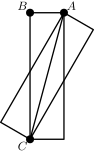 Continue the process, adding a third card to the second, and so on, lining up successive diagonals after rotating clockwise. In total, how many cards must be used until a vertex of a new card lands exactly on the vertex labeled in the figure?
Continue the process, adding a third card to the second, and so on, lining up successive diagonals after rotating clockwise. In total, how many cards must be used until a vertex of a new card lands exactly on the vertex labeled in the figure?Answer choices
Show solution
Solution
A diagonal makes an angle with a long side, where Thus the acute angle between the two diagonals of a card is
Each new card shares one diagonal with the previous card, and its other diagonal is the next line obtained by turning clockwise. All these equal diagonals have the same midpoint and are diameters of one common circle. The line through the original card’s other diagonal, which contains is counterclockwise from As an unoriented line, this is the same as clockwise from Five additions advance the unused diagonal by so the sixth card is the first new card with a vertex at
Thus, the correct answer is A.
Tagged: transformation · trigonometry