2020 AMC 10B Problem 21

Problem 21 of 25HarderGeometry

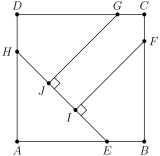
In square ABCD,ABCD, points EE and HH lie on AB\overline{AB} and DA,\overline{DA}, respectively, so that AE=AH.AE=AH. Points FF and GG lie on BC\overline{BC} and CD,\overline{CD}, respectively, and points II and JJ lie on EH\overline{EH} so that FIEH\overline{FI} \perp \overline{EH} and GJEH.\overline{GJ} \perp \overline{EH}. See the figure below. Triangle AEH,AEH, quadrilateral BFIE,BFIE, quadrilateral DHJG,DHJG, and pentagon FCGJIFCGJI each has area 1.1. What is FI2?FI^2?

Answer choices

Show solution

Solution

The four named regions fill the square and each has area 1,1, so the square has area 44 and side length 2.2. Since triangle AEHAEH is right isosceles with area 1,1, we have AE=AH=2.AE=AH=\sqrt2. Extend FIFI to meet ABAB at K,K, and set x=BFx=BF and t=BE=22.t=BE=2-\sqrt2. Because EHEH has slope 1,-1, line FKFK has slope 1,1, so BF=BK=x.BF=BK=x. If KK were on segment EB,EB, then region BFIEBFIE would lie inside triangle BFK,BFK, whose area would be at most t22<1,\frac{t^2}{2}<1, a contradiction. Thus KK lies to the left of E,E, and EK=xt.EK=x-t. Triangle BFKBFK is right isosceles with area x22.\frac{x^2}{2}. Triangle EIKEIK is right isosceles with hypotenuse EK=xt,EK=x-t, so its area is (xt)24.\frac{(x-t)^2}{4}. Since their difference is region BFIE,BFIE, 1=x22(xt)24.1=\frac{x^2}{2}-\frac{(x-t)^2}{4}. Therefore 4=2x2(xt)2=(x+t)22t2. \begin{aligned} 4&=2x^2-(x-t)^2\\ &=(x+t)^2-2t^2. \end{aligned} Also, FK=x2FK=x\sqrt2 and KI=xt2,KI=\frac{x-t}{\sqrt2}, so FI=FKKI=x+t2.FI=FK-KI=\frac{x+t}{\sqrt2}. It follows that FI2=(x+t)22=2+t2=2+(22)2=842. \begin{aligned} FI^2&=\frac{(x+t)^2}{2}\\ &=2+t^2\\ &=2+(2-\sqrt2)^2\\ &=8-4\sqrt2. \end{aligned} Thus, the correct answer is B .

More practice

Concepts: square (geometry) · area decomposition · special right triangle

Problem text and solution from the LIVE past-contest archive. See also the AoPS wiki page for community solutions.