2012 AMC 12B Problem 19
Problem 19 of 25HarderGeometryProblem-Solving Techniques
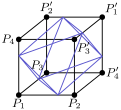
A unit cube has vertices and Vertices and are adjacent to and for vertices and are opposite to each other. A regular octahedron has one vertex in each of the segments and What is the octahedron’s side length?
Answer choices
Show solution
Solution
Place at the origin with edges along the axes, and let each of the three octahedron vertices near be a distance from by symmetry the three near are also a distance from
Two vertices sharing such as and are a distance apart. A vertex near say and the appropriate vertex near say must be the same distance apart.
Setting the two squared side lengths equal and using the cube’s unit edges yields so the side length is
Thus, the correct answer is A.
Tagged: cube geometry · Pythagorean Theorem · symmetry