
2012 AMC 12B Problem 21

Problem 21 of 25HarderGeometry

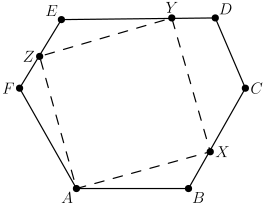
Square AXYZAXYZ is inscribed in equiangular hexagon ABCDEFABCDEF with XX on BC,\overline{BC}, YY on DE,\overline{DE}, and ZZ on EF.\overline{EF}. Suppose that AB=40AB = 40 and EF=41(31).EF = 41(\sqrt{3} - 1). What is the side-length of the square?
Answer choices

Show solution

Solution

Extend EFEF and CBCB to a line through AA perpendicular to both, meeting them at HH and J.J. Since ABJ=60,\angle ABJ=60^\circ, we have BJ=20BJ=20 and AJ=203.AJ=20\sqrt3. With u=BX,u=BX, the Pythagorean theorem gives s2=(20+u)2+(203)2.s^2=(20+u)^2+(20\sqrt3)^2. The equiangular angles make the four corner triangles congruent, and chasing the equal segments along EFEF yields u+203=41(31)+20+u3, \begin{aligned} u+20\sqrt3 &= 41(\sqrt3-1) \\ &\quad {}+\frac{20+u}{\sqrt3}, \end{aligned} so u=21320.u=21\sqrt3-20. Since 20+u=213,20+u=21\sqrt3, we get s2=(213)2+(203)2=3(441+400)=3292, \begin{aligned} s^2 &= (21\sqrt3)^2+(20\sqrt3)^2 \\ &= 3(441+400)=3\cdot29^2, \end{aligned} giving s=293.s=29\sqrt3. Thus, the correct answer is A.

More practice

Concepts: equiangular polygon · congruence (geometry) · Pythagorean Theorem

Problem text and solution from the LIVE past-contest archive. See also the AoPS wiki page for community solutions.