2016 AMC 12B Problem 17

Problem 17 of 25IntermediateGeometry

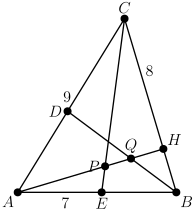
In ABC\triangle ABC shown in the figure, AB=7,AB=7, BC=8,BC=8, CA=9,CA=9, and AH\overline{AH} is an altitude. Points DD and EE lie on sides AC\overline{AC} and AB,\overline{AB}, respectively, so that BD\overline{BD} and CE\overline{CE} are angle bisectors, intersecting AH\overline{AH} at QQ and P,P, respectively. What is PQ?PQ?

Answer choices

Show solution

Solution

Let x=BH.x=BH. Then CH=8x,CH=8-x, and from the two right triangles AH2=72x2=92(8x)2.AH^2=7^2-x^2=9^2-(8-x)^2. This gives x=2x=2 and AH=45.AH=\sqrt{45}. By the angle bisector theorem in ACH,\triangle ACH, APPH=CACH=96,\dfrac{AP}{PH}=\dfrac{CA}{CH}=\dfrac96, so AP=35AH.AP=\dfrac35 AH. Similarly in ABH,\triangle ABH, AQQH=BABH=72,\dfrac{AQ}{QH}=\dfrac{BA}{BH}=\dfrac72, so AQ=79AH.AQ=\dfrac79 AH. Then PQ=AQAP=(7935)AH=84545=8155. \begin{aligned} PQ &= AQ-AP \\ &= \left(\dfrac79-\dfrac35\right)AH \\ &= \dfrac{8}{45}\sqrt{45} \\ &= \dfrac{8}{15}\sqrt5. \end{aligned} Thus, the correct answer is D.

More practice

Concepts: angle bisector theorem · altitude · Pythagorean Theorem

Problem text and solution from the LIVE past-contest archive. See also the AoPS wiki page for community solutions.