2021 AMC 12B Problem 24
Problem 24 of 25HarderGeometry
Let be a parallelogram with area Points and are the projections of and respectively, onto the line and points and are the projections of and respectively, onto the line See the figure, which also shows the relative locations of these points.
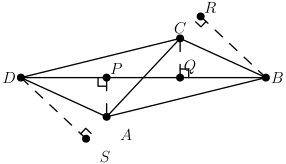 Suppose and and let denote the length of the longer diagonal of Then can be written in the form where and are positive integers and is not divisible by the square of any prime. What is
Suppose and and let denote the length of the longer diagonal of Then can be written in the form where and are positive integers and is not divisible by the square of any prime. What is Answer choices
Show solution
Solution
Let the diagonals meet at at angle The feet of the perpendiculars from and to are symmetric about so likewise
The parallelogram’s area is so Then giving
Writing gives so
Then so
Thus, the correct answer is A.
Tagged: parallelogram · trigonometry · area