2022 AMC 12B Problem 25
Problem 25 of 25HarderGeometry
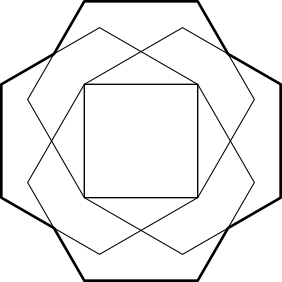
Four regular hexagons surround a square with a side length each one sharing an edge with the square, as shown in the figure below. The area of the resulting -sided outer nonconvex polygon can be written as where and are integers and is not divisible by the square of any prime. What is
Answer choices
Show solution
Solution
Center the square at the origin with vertices Each hexagon shares one edge with the square and extends across to the opposite side; the hexagon on the bottom edge, for instance, has its far (top) edge from to
The outer boundary is a -gon with flat edges at distance from the center, convex vertices such as and four reflex notches where adjacent hexagons’ slanted edges meet, at and its symmetric images.
Applying the shoelace formula to these vertices gives area so and
Thus, the correct answer is B.
Tagged: regular polygon · coordinate geometry · shoelace formula