2025 AMC 10B Problem 12
Problem 12 of 25IntermediateGeometry
The figure below shows an equilateral triangle, a rhombus with a angle, and a regular hexagon, each of them containing some mutually tangent congruent disks. Let and respectively, denote the ratio in each case of the total area of the disks to the area of the enclosing polygon.
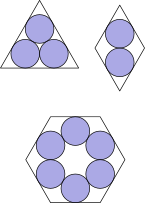 Which of the following is true?
Which of the following is true?Answer choices
Show solution
Solution
Take the triangle with side Three disks of radius give so For the rhombus with side the two disks sit on the long diagonal so and For the hexagon with side each of the six disks touches a side at its midpoint, again giving and So Therefore, the answer is C.
Tagged: tangent circles · area ratio · regular polygon