2025 AMC 10B Problem 25
Problem 25 of 25HarderGeometryNumber Theory
Square has sides of length Points and lie on and respectively, with and A path begins along the line segment from to and continues by reflecting against the sides of (with congruent incoming and outgoing angles), as shown in the figure. If the path hits a vertex of the square, then it terminates there; otherwise it continues forever.
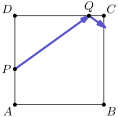 At which vertex does the path terminate?
At which vertex does the path terminate?Answer choices
Show solution
Solution
Place so and The initial direction is Unfold the billiard into a grid of reflected copies and follow the straight line from At a grid corner the horizontal coordinate gives The vertical coordinate then requires so The first positive possibility is giving and the unfolded corner Crossing cells across (odd) puts it on the side and cells up (even) puts it on That’s vertex Thus, B is the correct answer.
Tagged: reflection (geometry) · parity · greatest common divisor · coordinate geometry