2003 AMC 12B

All 25 problems from the 2003 AMC 12B. Take it as a timed mock test — 1:15:00 on the clock, scored the way the real contest is — or read through the problems and open any of them for hints and a worked solution.

25 problems · 6 points correct, 1.5 for blank, 0 for wrong
  1. Which of the following is the same as 2−4+6−8+10−12+143−6+9−12+15−18+21?\frac{2 - 4 + 6 - 8 + 10 - 12 + 14}{3 - 6 + 9 - 12 + 15 - 18 + 21}?
  2. Al gets the disease algebritis and must take one green pill and one pink pill each day for two weeks. A green pill costs $1\$1 more than a pink pill, and Al’s pills cost a total of $546\$546 for the two weeks. How much does one green pill cost?
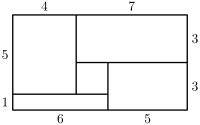
  3. Rose fills each of the rectangular regions of her rectangular flower bed with a different type of flower. The lengths, in feet, of the rectangular regions in her flower bed are as shown in the figure. She plants one flower per square foot in each region. Asters cost $1\$1 each, begonias $1.50\$1.50 each, cannas $2\$2 each, dahlias $2.50\$2.50 each, and Easter lilies $3\$3 each. What is the least possible cost, in dollars, for her garden?
  4. Moe uses a mower to cut his rectangular 9090-foot by 150150-foot lawn. The swath he cuts is 2828 inches wide, but he overlaps each cut by 44 inches to make sure that no grass is missed. He walks at the rate of 50005000 feet per hour while pushing the mower. Which of the following is closest to the number of hours it will take Moe to mow his lawn?
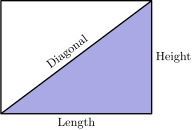
  5. Many television screens are rectangles that are measured by the length of their diagonals. The ratio of the horizontal length to the height in a standard television screen is 4:3.4 : 3. The horizontal length of a 2727-inch television screen is closest, in inches, to which of the following?
  6. The second and fourth terms of a geometric sequence are 22 and 6.6. Which of the following is a possible first term?
  7. Penniless Pete’s piggy bank has no pennies in it, but it has 100100 coins, all nickels, dimes, and quarters, whose total value is $8.35.\$8.35. It does not necessarily contain coins of all three types. What is the difference between the largest and smallest number of dimes that could be in the bank?
  8. Let ♣(x)\clubsuit(x) denote the sum of the digits of the positive integer x.x. For example, ♣(8)=8\clubsuit(8) = 8 and ♣(123)=1+2+3=6.\clubsuit(123) = 1 + 2 + 3 = 6. For how many two-digit values of xx is ♣(♣(x))=3?\clubsuit(\clubsuit(x)) = 3?
  9. Let ff be a linear function for which f(6)−f(2)=12.f(6) - f(2) = 12. What is f(12)−f(2)?f(12) - f(2)?
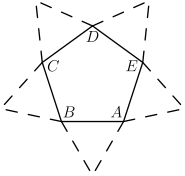
  10. Several figures can be made by attaching two equilateral triangles to the regular pentagon ABCDEABCDE in two of the five positions shown. How many non-congruent figures can be constructed in this way?
  11. Cassandra sets her watch to the correct time at noon. At the actual time of 1:001{:}00 PM, she notices that her watch reads 12:5712{:}57 and 3636 seconds. Assuming that her watch loses time at a constant rate, what will be the actual time when her watch first reads 10:0010{:}00 PM?
  12. What is the largest integer that is a divisor of (n+1)(n+3)(n+5)⋅(n+7)(n+9) \begin{aligned} &(n + 1)(n + 3)(n + 5) \\ &\quad {}\cdot (n + 7)(n + 9) \end{aligned} for all positive even integers n?n?
  13. An ice cream cone consists of a sphere of vanilla ice cream and a right circular cone that has the same diameter as the sphere. If the ice cream melts, it will exactly fill the cone. Assume that the melted ice cream occupies 75%75\% of the volume of the frozen ice cream. What is the ratio of the cone’s height to its radius?
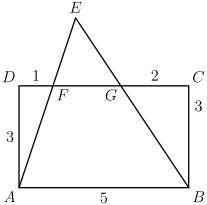
  14. In rectangle ABCD,ABCD, AB=5AB = 5 and BC=3.BC = 3. Points FF and GG are on CD‾\overline{CD} so that DF=1DF = 1 and GC=2.GC = 2. Lines AFAF and BGBG intersect at E.E. Find the area of △AEB.\triangle AEB.
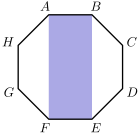
  15. A regular octagon ABCDEFGHABCDEFGH has an area of one square unit. What is the area of the rectangle ABEF?ABEF?
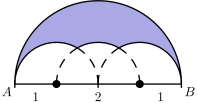
  16. Three semicircles of radius 11 are constructed on diameter AB‾\overline{AB} of a semicircle of radius 2.2. The centers of the small semicircles divide AB‾\overline{AB} into four line segments of equal length, as shown. What is the area of the shaded region that lies within the large semicircle but outside the smaller semicircles?
  17. If log⁡(xy3)=1\log(xy^3) = 1 and log⁡(x2y)=1,\log(x^2y) = 1, what is log⁡(xy)?\log(xy)?
  18. Let xx and yy be positive integers such that 7x5=11y13.7x^5 = 11y^{13}. The minimum possible value of xx has a prime factorization acbd.a^c b^d. What is a+b+c+d?a + b + c + d?
  19. Let SS be the set of permutations of the sequence 1,1, 2,2, 3,3, 4,4, 55 for which the first term is not 1.1. A permutation is chosen randomly from S.S. The probability that the second term is 2,2, in lowest terms, is ab.\frac{a}{b}. What is a+b?a + b?
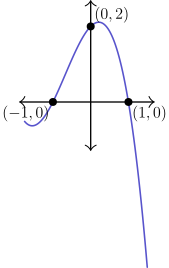
  20. Part of the graph of f(x)=ax3+bx2+cx+df(x) = ax^3 + bx^2 + cx + d is shown. What is b?b?
  21. An object moves 88 cm in a straight line from AA to B,B, turns at an angle α,\alpha, measured in radians and chosen at random from the interval (0,π),(0, \pi), and moves 55 cm in a straight line to C.C. What is the probability that AC<7?AC \lt 7?
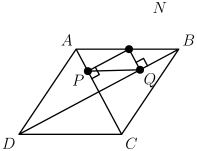
  22. Let ABCDABCD be a rhombus with AC=16AC = 16 and BD=30.BD = 30. Let NN be a point on AB‾,\overline{AB}, and let PP and QQ be the feet of the perpendiculars from NN to AC‾\overline{AC} and BD‾,\overline{BD}, respectively. Which of the following is closest to the minimum possible value of PQ?PQ?
  23. The number of xx-intercepts on the graph of y=sin⁡(1x)y = \sin(\frac{1}{x}) in the interval (0.0001,0.001)(0.0001, 0.001) is closest to
  24. Positive integers a,a, b,b, and cc are chosen so that a<b<c,a \lt b \lt c, and the system of equations 2x+y=20032x + y = 2003 and y=∣x−a∣+∣x−b∣+∣x−c∣ \begin{aligned} &y = |x - a| + |x - b| \\ &\quad {}+ |x - c| \end{aligned} has exactly one solution. What is the minimum value of c?c?
  25. Three points are chosen randomly and independently on a circle. What is the probability that all three pairwise distances between the points are less than the radius of the circle?

0 of 25 answered. Each problem left blank still scores 1.5 points.

Practise one problem at a time, with hints and solutions, on the practice page. Or work through the same ideas across every year by topic, or browse the full AMC 12 archive.