2003 AMC 12B Problem 22
Problem 22 of 25HarderGeometryProblem-Solving Techniques
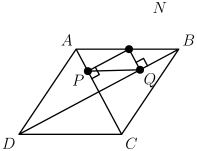
Let be a rhombus with and Let be a point on and let and be the feet of the perpendiculars from to and respectively. Which of the following is closest to the minimum possible value of
Answer choices
Show solution
Solution
Let be the intersection of the diagonals. Then is right-angled at with legs and Quadrilateral has right angles at and so it is a rectangle and
The minimum of is the altitude from to in Since equating the two area expressions gives
This is closest to
Thus, the correct answer is C.
Tagged: rhombus · altitude · optimization