2014 AMC 12B Problem 21

Problem 21 of 25HarderGeometry

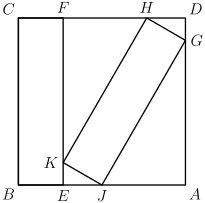
In the figure, ABCDABCD is a square of side length 1.1. The rectangles JKHGJKHG and EBCFEBCF are congruent. What is BE?BE?

Answer choices

Show solution

Solution

Let x=BE=GH=CFx = BE = GH = CF and θ=DHG=AGJ\theta = \angle DHG = \angle AGJ =FKH,= \angle FKH, with AD=GJ=HK=1.AD = GJ = HK = 1. In right triangle GDH,GDH, xsinθ=DG=1cosθ,x \sin\theta = DG = 1 - \cos\theta, so x=1cosθsinθ.x = \dfrac{1 - \cos\theta}{\sin\theta}. Along side CD,CD, 1=CF+FH+HD=x+sinθ+xcosθ. \begin{gathered} 1 = CF + FH + HD \\ = x + \sin\theta + x\cos\theta. \end{gathered} Substituting for xx gives 1=(1cosθ)(1+cosθ)sinθ+sinθ=sin2θsinθ+sinθ=2sinθ. \begin{gathered} 1 = \dfrac{(1-\cos\theta)(1+\cos\theta)}{\sin\theta} \\ {}+ \sin\theta \\ = \dfrac{\sin^2\theta}{\sin\theta} \\ {}+ \sin\theta \\ = 2\sin\theta. \end{gathered} Hence sinθ=12,\sin\theta = \tfrac12, so θ=30\theta = 30^\circ and x=13212=23. x = \dfrac{1 - \frac{\sqrt3}{2}}{\frac12} = 2 - \sqrt3. Thus, the correct answer is C.

More practice

Concepts: right triangle · trigonometry · angle chasing

Problem text and solution from the LIVE past-contest archive. See also the AoPS wiki page for community solutions.