2019 AMC 12B Problem 10
Problem 10 of 25EasierNumber TheoryCombinatoricsProblem-Solving Techniques
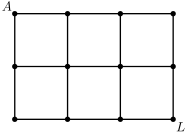
The figure below is a map showing cities and roads connecting certain pairs of cities. Paula wishes to travel along exactly of those roads, starting at city and ending at city without traveling along any portion of a road more than once. (Paula is allowed to visit a city more than once.) How many different routes can Paula take?
Answer choices
Show solution
Solution
Name the four cities in the top row those in the middle row and those in the bottom row A route using roads is an open Euler trail, so in the used graph exactly and have odd degree.
In the full map, the vertices whose degree parity must change are Because only roads are removed, those roads must pair these vertices. Among them, is adjacent only to forcing to be removed; then is forced. Similarly is adjacent only to forcing and then
The remaining graph is a chain Each of the two -cycles can be traversed in either direction, and everything else is forced. Hence there are routes.
Thus, E is the correct answer.
Tagged: graph theory · parity · casework