
2021 AMC 12A

All 25 problems from the 2021 AMC 12A. Take it as a timed mock test — 1:15:00 on the clock, scored the way the real contest is — or read through the problems and open any of them for hints and a worked solution.

25 problems · 6 points correct, 1.5 for blank, 0 for wrong
  1. What is the value of 21+2+3−(21+22+23)? 2^{1+2+3} - \left(2^1 + 2^2 + 2^3\right)?
  2. Under what conditions is a2+b2=a+b\sqrt{a^2 + b^2} = a + b true, where aa and bb are real numbers?
  3. The sum of two natural numbers is 17,402.17{,}402. One of the two numbers is divisible by 10.10. If the units digit of that number is erased, the other number is obtained. What is the difference of these two numbers?
  4. Tom has a collection of 1313 snakes, 44 of which are purple and 55 of which are happy. He observes that • all of his happy snakes can add, • none of his purple snakes can subtract, and • all of his snakes that can’t subtract also can’t add. Which of these conclusions can be drawn about Tom’s snakes?
  5. When a student multiplied the number 6666 by the repeating decimal 1.ab‾=1.ababab…, 1.\overline{ab} = 1.ababab\ldots, where aa and bb are digits, he did not notice the notation and just multiplied 6666 by the terminating decimal 1.ab.1.ab. Later he found that his answer was 0.50.5 less than the correct answer. What is the two-digit integer ab‾?\overline{ab}?
  6. A deck of cards has only red cards and black cards. The probability of a randomly chosen card being red is 13.\dfrac13. When 44 black cards are added to the deck, the probability of choosing red becomes 14.\dfrac14. How many cards were in the deck originally?
  7. What is the least possible value of (xy−1)2+(x+y)2(xy - 1)^2 + (x + y)^2 for real numbers xx and y?y?
  8. A sequence of numbers is defined by D0=0,D_0 = 0, D1=0,D_1 = 0, D2=1,D_2 = 1, and Dn=Dn−1+Dn−3D_n = D_{n-1} + D_{n-3} for n≥3.n \ge 3. What are the parities (evenness or oddness) of the triple of numbers (D2021,D2022,D2023),(D_{2021}, D_{2022}, D_{2023}), where EE denotes even and OO denotes odd?
  9. Which of the following is equivalent to (2+3)(22+32)(24+34)⋅(28+38)(216+316)⋅(232+332)(264+364)? \begin{aligned} &(2 + 3)(2^2 + 3^2)(2^4 + 3^4) \\ &\quad {}\cdot (2^8 + 3^8)(2^{16} + 3^{16}) \\ &\quad {}\cdot (2^{32} + 3^{32})(2^{64} + 3^{64})? \end{aligned}
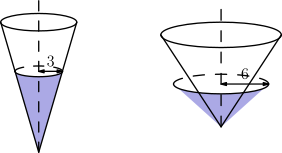
  10. Two right circular cones with vertices facing down as shown in the figure below contain the same amount of liquid. The radii of the tops of the liquid surfaces are 33 cm and 66 cm. Into each cone is dropped a spherical marble of radius 11 cm, which sinks to the bottom and is completely submerged without spilling any liquid. What is the ratio of the rise of the liquid level in the narrow cone to the rise of the liquid level in the wide cone?
  11. A laser is placed at the point (3,5).(3, 5). The laser beam travels in a straight line. Larry wants the beam to hit and bounce off the yy-axis, then hit and bounce off the xx-axis, then hit the point (7,5).(7, 5). What is the total distance the beam will travel along this path?
  12. All the roots of the polynomial z6−10z5+Az4z^6 - 10z^5 + Az^4 +Bz3+Cz2+Dz+16+ Bz^3 + Cz^2 + Dz + 16 are positive integers, possibly repeated. What is the value of B?B?
  13. Of the following complex numbers z,z, which one has the property that z5z^5 has the greatest real part?
  14. What is the value of (∑k=120log⁡5k3k2)⋅(∑k=1100log⁡9k25k)? \begin{aligned} &\left(\sum_{k=1}^{20} \log_{5^k} 3^{k^2}\right) \\ &\quad {}\cdot \left(\sum_{k=1}^{100} \log_{9^k} 25^k\right)? \end{aligned}
  15. A choir director must select a group of singers from among his 66 tenors and 88 basses. The only requirements are that the difference between the number of tenors and basses must be a multiple of 4,4, and the group must have at least one singer. Let NN be the number of groups that can be selected. What is the remainder when NN is divided by 100?100?
  16. In the following list of numbers, the integer nn appears nn times in the list for 1≤n≤200.1 \le n \le 200. 1,1, 2,2, 2,2, 3,3, 3,3, 3,3, 4,4, 4,4, 4,4, 4,4, …,\ldots, 200,200, 200,200, …,\ldots, 200200 What is the median of the numbers in this list?
  17. Trapezoid ABCDABCD has AB∥CD,AB \parallel CD, BC=CD=43,BC = CD = 43, and AD⊥BD.AD \perp BD. Let OO be the intersection of the diagonals ACAC and BD,BD, and let PP be the midpoint of BD.BD. Given that OP=11,OP = 11, the length ADAD can be written in the form mn,m\sqrt n, where mm and nn are positive integers and nn is not divisible by the square of any prime. What is m+n?m + n?
  18. Let ff be a function defined on the set of positive rational numbers with the property that f(a⋅b)=f(a)+f(b)f(a\cdot b) = f(a) + f(b) for all positive rational numbers aa and b.b. Suppose that ff also has the property that f(p)=pf(p) = p for every prime number p.p. For which of the following numbers xx is f(x)<0?f(x) \lt 0?
  19. How many solutions does the equation sin⁡(π2cos⁡x)=cos⁡(π2sin⁡x) \sin\left(\frac{\pi}{2}\cos x\right) = \cos\left(\frac{\pi}{2}\sin x\right) have in the closed interval [0,π]?[0, \pi]?
  20. Suppose that on a parabola with vertex VV and a focus FF there exists a point AA such that AF=20AF = 20 and AV=21.AV = 21. What is the sum of all possible values of the length FV?FV?
  21. The five solutions to the equation (z−1)(z2+2z+4)⋅(z2+4z+6)=0 \begin{aligned} &(z - 1)(z^2 + 2z + 4) \\ &\quad {}\cdot (z^2 + 4z + 6) = 0 \end{aligned} may be written in the form xk+ykix_k + y_k i for 1≤k≤5,1 \le k \le 5, where xkx_k and yky_k are real. Let EE be the unique ellipse that passes through the points (x1,y1),(x_1, y_1), (x2,y2),(x_2, y_2), (x3,y3),(x_3, y_3), (x4,y4),(x_4, y_4), and (x5,y5).(x_5, y_5). The eccentricity of EE can be written in the form mn,\sqrt{\tfrac{m}{n}}, where mm and nn are relatively prime positive integers. What is m+n?m + n? (Recall that the eccentricity of an ellipse EE is the ratio ca,\tfrac{c}{a}, where 2a2a is the length of the major axis of EE and 2c2c is the distance between its two foci.)
  22. Suppose that the roots of the polynomial P(x)=x3+ax2+bx+cP(x) = x^3 + ax^2 + bx + c are cos⁡2π7,\cos\tfrac{2\pi}{7}, cos⁡4π7,\cos\tfrac{4\pi}{7}, and cos⁡6π7,\cos\tfrac{6\pi}{7}, where angles are in radians. What is abc?abc?
  23. Frieda the frog begins a sequence of hops on a 3×33\times 3 grid of squares, moving one square on each hop and choosing at random the direction of each hop: up, down, left, or right. She does not hop diagonally. When the direction of a hop would take Frieda off the grid, she “wraps around” and jumps to the opposite edge. For example, if Frieda begins in the center square and makes two hops “up,” the first hop places her in the top row middle square, and the second hop causes her to jump to the opposite edge, landing in the bottom row middle square. Suppose Frieda starts from the center square, makes at most four hops at random, and stops hopping if she lands on a corner square. What is the probability that she reaches a corner square on one of the four hops?
  24. Semicircle Γ\Gamma has diameter ABAB of length 14.14. Circle Ω\Omega lies tangent to ABAB at a point PP and intersects Γ\Gamma at points QQ and R.R. If QR=33QR = 3\sqrt3 and ∠QPR=60∘,\angle QPR = 60^\circ, then the area of △PQR\triangle PQR is abc,\dfrac{a\sqrt b}{c}, where aa and cc are relatively prime positive integers and bb is a positive integer not divisible by the square of any prime. What is a+b+c?a + b + c?
  25. Let d(n)d(n) denote the number of positive integers that divide n,n, including 11 and n.n. For example, d(1)=1,d(1) = 1, d(2)=2,d(2) = 2, and d(12)=6.d(12) = 6. (This function is known as the divisor function.) Let f(n)=d(n)n3. f(n) = \frac{d(n)}{\sqrt[3]{n}}. There is a unique positive integer NN such that f(N)>f(n)f(N) \gt f(n) for all positive integers n≠N.n \ne N. What is the sum of the digits of N?N?

0 of 25 answered. Each problem left blank still scores 1.5 points.

Practise one problem at a time, with hints and solutions, on the practice page. Or work through the same ideas across every year by topic, or browse the full AMC 12 archive.