2025 AMC 12A Problem 5
In the figure below, the outside square contains infinitely many squares, each of them with the same center and sides parallel to the outside square. The ratio of the side length of a square to the side length of the next inner square is where The spaces between squares are alternately shaded, as shown in the figure (which is not necessarily drawn to scale).
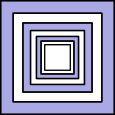 The area of the shaded portion of the figure is of the area of the original square. What is
The area of the shaded portion of the figure is of the area of the original square. What is Answer choices
Show solution
Solution
Let the outer square have area The nested squares have areas so the ring between the th and th squares has area
The shaded rings are the alternate ones with total area
Setting gives so and
Thus, the correct answer is D.
Tagged: geometric sequence · area ratio