2010 AMC 10A Problem 14

Problem 14 of 25IntermediateGeometry

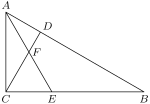
Triangle ABCABC has AB=2AC.AB=2 \cdot AC. Let DD and EE be on AB\overline{AB} and BC,\overline{BC}, respectively, such that BAE=ACD.\angle BAE = \angle ACD. Let FF be the intersection of segments AEAE and CD,CD, and suppose that CFE\triangle CFE is equilateral. What is ACB?\angle ACB?

Answer choices

Show solution

Solution

Let BAE=ACD=x.\angle BAE = \angle ACD = x. Note that CFE=60\angle CFE = 60^{\circ} since CFE\triangle CFE is equilateral. We then have that AFC=180CFE=120. \angle AFC = 180^{\circ} - \angle CFE = 120^{\circ}. Then: FAC=180120x=60x=EAC.\begin{aligned} \angle FAC &= 180^{\circ} - 120^{\circ} - x\\ &=60^{\circ} - x \\ &= \angle EAC.\end{aligned} We then get that BAC=BAE+EAC=x+60x=60. \begin{aligned} \angle BAC &= \angle BAE + \angle EAC\\ &= x + 60^{\circ} - x \\&= 60^{\circ}. \end{aligned} Since AB=2ACAB = 2 \cdot AC and BAC=60,\angle BAC = 60^{\circ}, we have that ABC\triangle ABC is a 30609030-60-90 triangle. Thus, C is the correct answer.

More practice

Concepts: angle chasing · equilateral triangle · special right triangle

Problem text and solution from the LIVE past-contest archive. See also the AoPS wiki page for community solutions.