2013 AMC 10B Problem 23
Problem 23 of 25HarderGeometry
In triangle and Distinct points and lie on segments and respectively, such that and The length of segment can be written as where and are relatively prime positive integers. What is
Answer choices
Show solution
Solution
Let , so . Applying the Pythagorean Theorem to right triangles and gives Thus , , and .
This yields the following diagram:
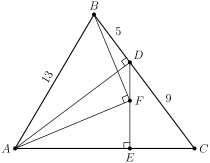 Because and , we have . Also, , so are concyclic. Hence In right triangle , and . Therefore, in right triangle ,
By Ptolemy’s Theorem, we get Therefore,
Dividing by gives , so . Thus , and the correct answer is B .
Because and , we have . Also, , so are concyclic. Hence In right triangle , and . Therefore, in right triangle ,
By Ptolemy’s Theorem, we get Therefore,
Dividing by gives , so . Thus , and the correct answer is B .
Because and , we have . Also, , so are concyclic. Hence In right triangle , and . Therefore, in right triangle ,
By Ptolemy’s Theorem, we get Therefore,
Dividing by gives , so . Thus , and the correct answer is B .Tagged: cyclic quadrilateral · Ptolemy’s Theorem · altitude · similarity