2016 AMC 10A Problem 21
Problem 21 of 25HarderGeometry
Circles with centers and having radii and respectively, lie on the same side of line and are tangent to at and respectively, with between and The circle with center is externally tangent to each of the other two circles. What is the area of
Answer choices
Show solution
Solution
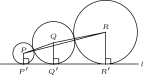 Put the tangent line on the -axis and take Because and the centers differ in height by the horizontal distance from to is Similarly, and its centers also differ in height by so their horizontal distance is
Thus we may use The coordinate-area formula gives
Thus, the correct answer is D .
Put the tangent line on the -axis and take Because and the centers differ in height by the horizontal distance from to is Similarly, and its centers also differ in height by so their horizontal distance is
Thus we may use The coordinate-area formula gives
Thus, the correct answer is D .Tagged: tangent circles · Pythagorean Theorem · coordinate geometry