2019 AMC 10B Problem 20
Problem 20 of 25HarderGeometry
As shown in the figure, line segment is trisected by points and so that Three semicircles of radius and have their diameters on , lie in the same halfplane determined by line , and are tangent to line at and respectively. A circle of radius has its center at The area of the region inside the circle but outside the three semicircles, shaded in the figure, can be expressed in the form where and are positive integers and and are relatively prime. What is
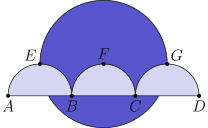
Answer choices
Show solution
Solution
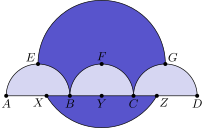 Line passes through the center of the radius- circle, so the shaded upper semicircle has area .
The chord lies on , one unit from . Thus The shaded circular segment below has area
The portion between and consists of four congruent pieces of the following form.
Line passes through the center of the radius- circle, so the shaded upper semicircle has area .
The chord lies on , one unit from . Thus The shaded circular segment below has area
The portion between and consists of four congruent pieces of the following form.
 Each piece is a unit square with a quarter of a unit circle removed, so the four pieces have total area
The total shaded area is therefore Hence , , , and , giving .
Thus, the answer is E .
Each piece is a unit square with a quarter of a unit circle removed, so the four pieces have total area
The total shaded area is therefore Hence , , , and , giving .
Thus, the answer is E .Tagged: sector · area decomposition · tangent circles