2021 AMC 10B Problem 21
Problem 21 of 25HarderGeometry
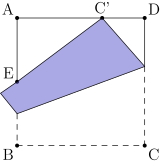
A square piece of paper has side length and vertices and in that order. As shown in the figure, the paper is folded so that vertex meets edge at point and edge intersects edge at point Suppose that What is the perimeter of
Answer choices
Show solution
Solution
Use coordinates with and Since we have so
The fold reflects to so the image of side is the line through and Reflecting across the perpendicular bisector of gives The line through this point and meets at
Thus and
The perimeter of is
Thus, the answer is A .
Tagged: paper folding · coordinate geometry