2021 AMC 10B Problem 24
Problem 24 of 25HarderCombinatorics
Arjun and Beth play a game in which they take turns removing one brick or two adjacent bricks from one “wall” among a set of several walls of bricks, with gaps possibly creating new walls. The walls are one brick tall. For example, a set of walls of sizes and can be changed into any of the following by one move: or
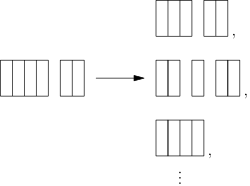 Arjun plays first, and the player who removes the last brick wins. For which starting configuration is there a strategy that guarantees a win for Beth?
Arjun plays first, and the player who removes the last brick wins. For which starting configuration is there a strategy that guarantees a win for Beth?Answer choices
Show solution
Solution
For a single wall of length compute its Sprague-Grundy value from the possible moves. For the wall lengths needed here, the values are
For several walls, the position is losing for the player to move exactly when the xor of the wall values is Evaluating the choices gives
Only is losing for the player to move, so Beth has a guaranteed win exactly for that starting configuration.
Thus, the answer is B .
Tagged: combinatorial game