2001 AMC 12 Problem 17

Problem 17 of 25IntermediateGeometryCounting & Probability

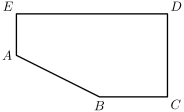
A point PP is selected at random from the interior of the pentagon with vertices A=(0,2),A = (0, 2), B=(4,0),B = (4, 0), C=(2π+1,0),C = (2\pi + 1, 0), D=(2π+1,4),D = (2\pi + 1, 4), and E=(0,4).E = (0, 4). What is the probability that APB\angle APB is obtuse?

Answer choices

Show solution

Solution

APB=90\angle APB = 90^\circ when PP is on the circle with diameter AB,AB, centered at (2,1)(2, 1) with radius AB2=202=5.\dfrac{|AB|}{2} = \dfrac{\sqrt{20}}{2} = \sqrt{5}. The angle is obtuse when PP is inside this circle. The relevant half-disk lies wholly within the pentagon, with area 12π(5)2=5π2.\dfrac{1}{2}\pi(\sqrt{5})^2 = \dfrac{5\pi}{2}. The pentagon is the rectangle with corners (0,0),(0,0), C,C, D,D, EE minus triangle OAB,OAB, so its area is 4(2π+1)12(2)(4)=8π. 4(2\pi + 1) - \dfrac{1}{2}(2)(4) = 8\pi. The probability is 5π28π=516.\dfrac{\frac{5\pi}{2}}{8\pi} = \dfrac{5}{16}. Thus, the correct answer is C.

More practice

Concepts: geometric probability · inscribed angle · area

Problem text and solution from the LIVE past-contest archive. See also the AoPS wiki page for community solutions.