
2004 AMC 12B Problem 24

Problem 24 of 25HarderAlgebraGeometry

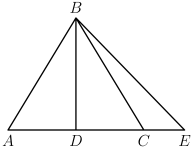
In ABC,\triangle ABC, AB=BC,AB = BC, and BD\overline{BD} is an altitude. Point EE is on the extension of AC\overline{AC} such that BE=10.BE = 10. The values of tanCBE,\tan \angle CBE, tanDBE,\tan \angle DBE, and tanABE\tan \angle ABE form a geometric progression, and the values of cotDBE,\cot \angle DBE, cotCBE,\cot \angle CBE, cotDBC\cot \angle DBC form an arithmetic progression. What is the area of ABC?\triangle ABC?
Answer choices

Show solution

Solution

Let DBE=α\angle DBE = \alpha and DBC=β.\angle DBC = \beta. Since BD\overline{BD} is the altitude of the isosceles triangle, CBE=αβ\angle CBE = \alpha - \beta and ABE=α+β.\angle ABE = \alpha + \beta. The geometric progression gives tan(αβ)tan(α+β)=tan2α,\tan(\alpha - \beta)\tan(\alpha + \beta) = \tan^2\alpha, which simplifies to tan2β(tan4α1)=0,\tan^2\beta(\tan^4\alpha - 1) = 0, so tanα=1\tan\alpha = 1 and α=45.\alpha = 45^\circ. Writing DC=aDC = a and BD=b,BD = b, the arithmetic progression cotDBE,\cot\angle DBE, cotCBE,\cot\angle CBE, cotDBC\cot\angle DBC becomes 1,b+aba,ba,1, \dfrac{b + a}{b - a}, \dfrac{b}{a}, forcing b=3a.b = 3a. With BE=10BE = 10 and DBE=45,\angle DBE = 45^\circ, we get b=BE2=52,b = \dfrac{BE}{\sqrt2} = 5\sqrt2, so a=523.a = \dfrac{5\sqrt2}{3}. The area of ABC\triangle ABC is 12(AC)(BD)=ab\tfrac12 (AC)(BD) = ab =52523= 5\sqrt2 \cdot \dfrac{5\sqrt2}{3} =503.= \dfrac{50}{3}. Thus, the correct answer is B.

More practice

Concepts: trigonometric identity · geometric sequence · isosceles triangle

Problem text and solution from the LIVE past-contest archive. See also the AoPS wiki page for community solutions.