2010 AMC 12A Problem 8
Problem 8 of 25EasierGeometry
Triangle has Let and be on and respectively, such that Let be the intersection of segments and and suppose that is equilateral. What is
Answer choices
Show solution
Solution
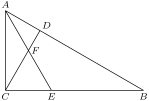 Let Because is equilateral, Rays and are opposite, so
In we get Since lies on this is Hence
Put so The Law of Cosines gives Thus the side lengths are in the ratio with the hypotenuse, so
Thus, C is the correct answer.
Let Because is equilateral, Rays and are opposite, so
In we get Since lies on this is Hence
Put so The Law of Cosines gives Thus the side lengths are in the ratio with the hypotenuse, so
Thus, C is the correct answer.Tagged: angle chasing · equilateral triangle · special right triangle