2022 AMC 10A Problem 13
Problem 13 of 25IntermediateGeometry
Let be a scalene triangle. Point lies on so that bisects The line through perpendicular to intersects the line through parallel to at point Suppose and What is
Answer choices
Show solution
Solution
Consider the following diagram:
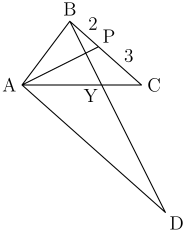 Let be the intersection of and By the Angle Bisector Theorem, so write and
Reflection across the angle bisector sends ray to ray Because it sends to Thus and hence
Since with collinear and collinear, we have Therefore
Finally, so
Thus, C is the correct answer.
Let be the intersection of and By the Angle Bisector Theorem, so write and
Reflection across the angle bisector sends ray to ray Because it sends to Thus and hence
Since with collinear and collinear, we have Therefore
Finally, so
Thus, C is the correct answer.
Let be the intersection of and By the Angle Bisector Theorem, so write and
Reflection across the angle bisector sends ray to ray Because it sends to Thus and hence
Since with collinear and collinear, we have Therefore
Finally, so
Thus, C is the correct answer.Tagged: angle bisector theorem · similarity · isosceles triangle