2022 AMC 10A Problem 23
Problem 23 of 25HarderGeometryProblem-Solving Techniques
Isosceles trapezoid has parallel sides and with and There is a point in the plane such that and What is
Answer choices
Show solution
Solution
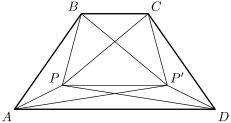 Let be the reflection of across the perpendicular bisector of
This forms two new isosceles trapezoids: and
Therefore, we get
Using Ptolemy’s theorem, we know that the product of the diagonals is equal to the sum of the products of the opposite sides. Therefore:
This gets us and Dividing these two equations yields
Thus, B is the correct answer.
Let be the reflection of across the perpendicular bisector of
This forms two new isosceles trapezoids: and
Therefore, we get
Using Ptolemy’s theorem, we know that the product of the diagonals is equal to the sum of the products of the opposite sides. Therefore:
This gets us and Dividing these two equations yields
Thus, B is the correct answer.Tagged: trapezoid · Ptolemy’s Theorem · symmetry