2022 AMC 10A Problem 25
Problem 25 of 25HarderGeometryNumber TheoryProblem-Solving Techniques
Let and be squares that have vertices at lattice points (i.e., points whose coordinates are both integers) in the coordinate plane, together with their interiors.
The bottom edge of each square is on the -axis. The left edge of and the right edge of are on the -axis, and contains as many lattice points as does The top two vertices of are in and contains of the lattice points contained in See the figure (not drawn to scale).
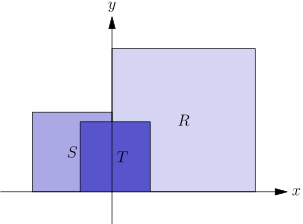 The fraction of lattice points in that are in is times the fraction of lattice points in that are in What is the minimum possible value of the edge length of plus the edge length of plus the edge length of
The fraction of lattice points in that are in is times the fraction of lattice points in that are in What is the minimum possible value of the edge length of plus the edge length of plus the edge length of Answer choices
Show solution
Solution
Let be the number of lattice points on the side length of Similarly define for and for Note that the number of lattice points in a rectangle is the product of the number of lattice points along its width and the number of lattice points along its length.
The first condition gives us that
The number of lattice points in is the sum of the lattice points in each of the regions, but there is overlap along the -axis where touches it.
The second condition, therefore, yields From we get that is a multiple of We can substitute with to get For the product to be divisible by must be divisible by We can again substitute with to get
Let be the number of lattice points along the bottom of the rectangle formed by and be the number of lattice points along the bottom of the rectangle formed by
Using these variables, we get that the number of lattice points in is and in is
The third condition gives us that
We also know that (accounting for overlap), and this yields
gives us that
However, by we get that
By we also get that is a perfect square since it is relatively prime to and they must multiply to a perfect square.
Thus must be a perfect square satisfying The smaller positive squares do not satisfy this congruence, while does, so is the least possible value.
From this value of we get that and We can also find that Therefore, The question, however, asked for the sum of the side lengths. The side lengths of the squares are less than the number of lattice points on the side, so we have to subtract
This value is attainable: equation gives and hence Since and a square with lattice points per side can straddle the -axis with the required overlaps, and its top vertices lie in
Therefore, the desired answer is
Thus, B is the correct answer.
Tagged: lattice point · modular arithmetic · optimization