2022 AMC 10A Problem 5
Square has side length Points and each lie on a side of such that is an equilateral convex hexagon with side length What is
Answer choices
Show solution
Solution
Consider the diagram:
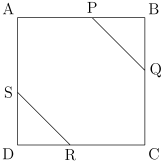 Since we know that This shows that is an isosceles right triangle with hypotenuse Using the Pythagorean theorem, we get that
We also know that
This equation simplifies to Which implies that
We can rationalize this fraction to get
Thus, C is the correct answer.
Since we know that This shows that is an isosceles right triangle with hypotenuse Using the Pythagorean theorem, we get that
We also know that
This equation simplifies to Which implies that
We can rationalize this fraction to get
Thus, C is the correct answer.
Since we know that This shows that is an isosceles right triangle with hypotenuse Using the Pythagorean theorem, we get that
We also know that
This equation simplifies to Which implies that
We can rationalize this fraction to get
Thus, C is the correct answer.Tagged: square (geometry) · special right triangle · rationalizing denominator