2022 AMC 10A Problem 21
Problem 21 of 25HarderGeometry
A bowl is formed by attaching four regular hexagons of side to a square of side The edges of the adjacent hexagons coincide, as shown in the figure. What is the area of the octagon obtained by joining the top eight vertices of the four hexagons, situated on the rim of the bowl?
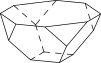
Answer choices
Show solution
Solution
View the rim from directly above. Place the bottom square at In a regular hexagon, an edge adjacent to the attached side has components parallel and perpendicular to that side.
At a corner of the bottom square, the corresponding edges of two adjacent hexagons coincide. Comparing their horizontal components shows that the horizontal component of a unit vector perpendicular to an attached side within its hexagon is The opposite side of a regular hexagon is units from the attached side, so its horizontal outward displacement is
Consequently, the four unit-length sides of the rim lie one unit beyond the four sides of the bottom square. Its top view is therefore a -by- square with four isosceles right corner triangles of leg removed:
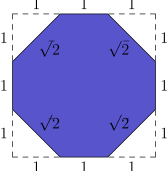 Its area is
Thus, B is the correct answer.
Its area is
Thus, B is the correct answer.
Its area is
Thus, B is the correct answer.Tagged: 3D geometry · regular polygon · area decomposition