2022 AMC 10B Problem 19
Problem 19 of 25HarderProblem-Solving Techniques
Each square in a grid is either filled or empty, and has up to eight adjacent neighboring squares, where neighboring squares share either a side or a corner. The grid is transformed by the following rules:
• Any filled square with two or three filled neighbors remains filled.
• Any empty square with exactly three filled neighbors becomes a filled square.
• All other squares remain empty or become empty.
A sample transformation is shown in the figure below.
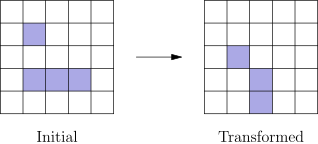 Suppose the grid has a border of empty squares surrounding a subgrid. How many initial configurations will lead to a transformed grid consisting of a single filled square in the center after a single transformation? (Rotations and reflections of the same configuration are considered different.)
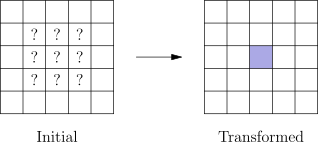
Suppose the grid has a border of empty squares surrounding a subgrid. How many initial configurations will lead to a transformed grid consisting of a single filled square in the center after a single transformation? (Rotations and reflections of the same configuration are considered different.)
Answer choices
Show solution
Solution
First suppose the center is initially filled. It must have exactly or filled neighbors to survive. Every such neighbor already touches the center, so to disappear it cannot touch any other filled neighbor. Checking these pairwise nonadjacent positions, the only choices that do not also give some empty square exactly filled neighbors are two opposite corners. There are such configurations.
Now suppose the center is initially empty. Exactly of its eight neighbors must be filled. Each of those three must disappear, so none may be adjacent to both of the others. Also, no empty square besides the center may be adjacent to all three. Applying these two tests gives the following four representative patterns:
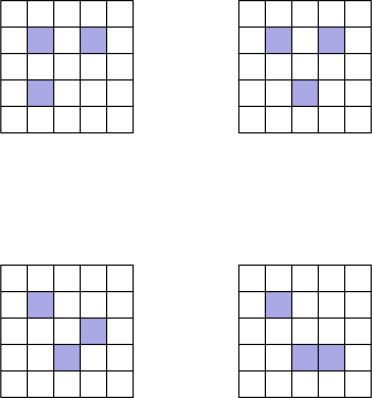 Each of the first three patterns has distinct rotations. The last has rotations and their reflected images, for configurations. Thus the center-empty case contributes and the total is
Thus, the answer is C .
Each of the first three patterns has distinct rotations. The last has rotations and their reflected images, for configurations. Thus the center-empty case contributes and the total is
Thus, the answer is C .
Each of the first three patterns has distinct rotations. The last has rotations and their reflected images, for configurations. Thus the center-empty case contributes and the total is
Thus, the answer is C .Tagged: process simulation · casework · symmetry