2022 AMC 10B Problem 20
Problem 20 of 25HarderGeometry
Let be a rhombus with Let be the midpoint of and let be the point on such that is perpendicular to What is the degree measure of
Answer choices
Show solution
Solution
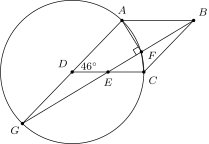 Extend to meet line at Because we have and are vertical angles. Also so Hence
Thus is the midpoint of The circle centered at through also passes through and Since Thales’ theorem places on this circle as well.
Because is opposite The inscribed angle subtending arc is therefore Finally, are collinear, so
Thus, the answer is D .
Extend to meet line at Because we have and are vertical angles. Also so Hence
Thus is the midpoint of The circle centered at through also passes through and Since Thales’ theorem places on this circle as well.
Because is opposite The inscribed angle subtending arc is therefore Finally, are collinear, so
Thus, the answer is D .Tagged: angle chasing · cyclic quadrilateral · inscribed angle