2000 AMC 12 Problem 22
Problem 22 of 25HarderAlgebra
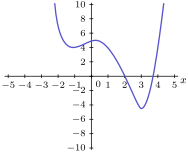
The graph below shows a portion of the curve defined by the quartic polynomial Which of the following is the smallest?
Answer choices
Show solution
Solution
The graph crosses the -axis exactly twice, both times at positive values, so has two real zeros and two non-real (complex conjugate) zeros.
Reading off the graph: the sum of the coefficients is the sum of the real zeros is greater than and the product of all zeros is the -intercept, which is less than
Let be the product of the real zeros, so The product of the non-real zeros is which is less than
This is smaller than every other listed quantity.
Thus, the correct answer is C.
Tagged: polynomial · Vieta’s Formulas · complex number