2000 AMC 12

All 25 problems from the 2000 AMC 12. Take it as a timed mock test — 1:15:00 on the clock, scored the way the real contest is — or read through the problems and open any of them for hints and a worked solution.

25 problems · 6 points correct, 1.5 for blank, 0 for wrong
  1. In the year 2001,2001, the United States will host the International Mathematical Olympiad. Let I,I, M,M, and OO be distinct positive integers such that the product I⋅M⋅O=2001.I \cdot M \cdot O = 2001. What is the largest possible value of the sum I+M+O?I + M + O?
  2. What is 2000(20002000)?2000(2000^{2000})?
  3. Each day, Jenny ate 20%20\% of the jellybeans that were in her jar at the beginning of that day. At the end of the second day, 3232 remained. How many jellybeans were in the jar originally?
  4. The Fibonacci sequence 1,1, 1,1, 2,2, 3,3, 5,5, 8,8, 13,13, 21,21, …\ldots starts with two 11s, and each term afterwards is the sum of its two predecessors. Which one of the ten digits is the last to appear in the units position of a number in the Fibonacci sequence?
  5. If ∣x−2∣=p,|x - 2| = p, where x<2,x \lt 2, then what is x−p?x - p?
  6. Two different prime numbers between 44 and 1818 are chosen. When their sum is subtracted from their product, which of the following numbers could be obtained?
  7. How many positive integers bb have the property that log⁡b729\log_b 729 is a positive integer?
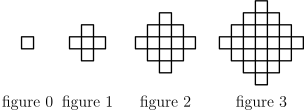
  8. Figures 0,0, 1,1, 2,2, and 33 consist of 1,1, 5,5, 13,13, and 2525 nonoverlapping unit squares, respectively. If the pattern were continued, how many nonoverlapping unit squares would there be in figure 100?100?
  9. Mrs. Walter gave an exam in a mathematics class of five students. She entered the scores in random order into a spreadsheet, which recalculated the class average after each score was entered. Mrs. Walter noticed that after each score was entered, the average was always an integer. The scores (listed in ascending order) were 71,71, 76,76, 80,80, 82,82, and 91.91. What was the last score Mrs. Walter entered?
  10. The point P=(1,2,3)P = (1, 2, 3) is reflected in the xyxy-plane, then its image QQ is rotated by 180∘180^\circ about the xx-axis to produce R,R, and finally, RR is translated by 55 units in the positive yy direction to produce S.S. What are the coordinates of S?S?
  11. Two non-zero real numbers, aa and b,b, satisfy ab=a−b.ab = a - b. Find a possible value of ab+ba−ab.\frac{a}{b} + \frac{b}{a} - ab.
  12. Let A,A, M,M, and CC be nonnegative integers such that A+M+C=12.A + M + C = 12. What is the maximum value of A⋅M⋅C+A⋅M+M⋅C+C⋅A? \begin{aligned} &A \cdot M \cdot C + A \cdot M \\ &\quad {}+ M \cdot C + C \cdot A? \end{aligned}
  13. One morning each member of Angela’s family drank an 88-ounce mixture of coffee with milk. The amounts of coffee and milk varied from cup to cup, but were never zero. Angela drank a quarter of the total amount of milk and a sixth of the total amount of coffee. How many people are in the family?
  14. When the mean, median, and mode of the list 10,2,5,2,4,2,x10, 2, 5, 2, 4, 2, x are arranged in increasing order, they form a non-constant arithmetic progression. What is the sum of all possible real values of x?x?
  15. Let ff be a function for which f ⁣(x3)=x2+x+1.f\!\left(\dfrac{x}{3}\right) = x^2 + x + 1. Find the sum of all values of zz for which f(3z)=7.f(3z) = 7.
  16. A checkerboard of 1313 rows and 1717 columns has a number written in each square, beginning in the upper left corner, so that the first row is numbered 1,1, 2,2, …,\ldots, 17,17, the second row 18,18, 19,19, …,\ldots, 34,34, and so on down the board. If the board is renumbered so that the left column, top to bottom, is 1,1, 2,2, …,\ldots, 13,13, the second column 14,14, 15,15, …,\ldots, 2626 and so on across the board, some squares have the same numbers in both numbering systems. Find the sum of the numbers in these squares (under either system).
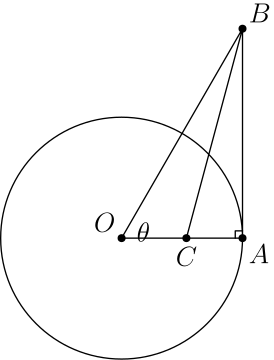
  17. A circle centered at OO has radius 11 and contains the point A.A. Segment ABAB is tangent to the circle at AA and ∠AOB=θ.\angle AOB = \theta. If point CC lies on OA‾\overline{OA} and BCBC bisects ∠ABO,\angle ABO, then what is OC?OC?
  18. In year N,N, the 300300th day of the year is a Tuesday. In year N+1,N + 1, the 200200th day is also a Tuesday. On what day of the week did the 100100th day of year N−1N - 1 occur?
  19. In triangle ABC,ABC, AB=13,AB = 13, BC=14,BC = 14, and AC=15.AC = 15. Let DD denote the midpoint of BC‾\overline{BC} and let EE denote the intersection of BC‾\overline{BC} with the bisector of angle BAC.BAC. Which of the following is closest to the area of triangle ADE?ADE?
  20. If x,x, y,y, and zz are positive numbers satisfying x+1y=4,x + \frac{1}{y} = 4, y+1z=1,y + \frac{1}{z} = 1, and z+1x=73,z + \frac{1}{x} = \frac{7}{3}, then what is xyz?xyz?
  21. Through a point on the hypotenuse of a right triangle, lines are drawn parallel to the legs of the triangle so that the triangle is divided into a square and two smaller right triangles. The area of one of the two small right triangles is mm times the area of the square. What is the ratio of the area of the other small right triangle to the area of the square?
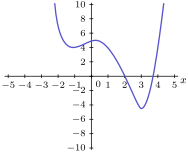
  22. The graph below shows a portion of the curve defined by the quartic polynomial P(x)=x4+ax3+bx2+cx+d.P(x) = x^4 + ax^3 + bx^2 + cx + d. Which of the following is the smallest?
  23. Professor Gamble buys a lottery ticket, which requires that he pick six different integers from 11 through 46,46, inclusive. He chooses his numbers so that the sum of the base-ten logarithms of his six numbers is an integer. It so happens that the integers on the winning ticket have the same property -- the sum of the base-ten logarithms is an integer. What is the probability that Professor Gamble holds the winning ticket?
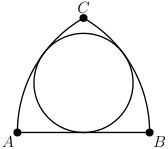
  24. If circular arcs ACAC and BCBC have centers at BB and A,A, respectively, then there exists a circle tangent to both arc ACAC and arc BC,BC, and to AB‾.\overline{AB}. If the length of arc BCBC is 12,12, then what is the circumference of the circle?
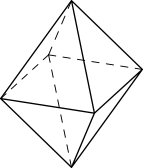
  25. Eight congruent equilateral triangles, each of a different color, are used to construct a regular octahedron. How many distinguishable ways are there to construct the octahedron? (Two colored octahedrons are distinguishable if neither can be rotated to look just like the other.)

0 of 25 answered. Each problem left blank still scores 1.5 points.

Practise one problem at a time, with hints and solutions, on the practice page. Or work through the same ideas across every year by topic, or browse the full AMC 12 archive.