2011 AMC 12B

All 25 problems from the 2011 AMC 12B. Take it as a timed mock test — 1:15:00 on the clock, scored the way the real contest is — or read through the problems and open any of them for hints and a worked solution.

25 problems · 6 points correct, 1.5 for blank, 0 for wrong
  1. What is 2+4+61+3+5−1+3+52+4+6?\dfrac{2+4+6}{1+3+5} - \dfrac{1+3+5}{2+4+6}?
  2. Josanna’s test scores to date are 90,90, 80,80, 70,70, 60,60, and 85.85. Her goal is to raise her test average at least 33 points with her next test. What is the minimum test score she would need to accomplish this goal?
  3. LeRoy and Bernardo went on a week-long trip together and agreed to share the costs equally. Over the week, each of them paid for various joint expenses such as gasoline and car rental. At the end of the trip it turned out that LeRoy had paid AA dollars and Bernardo had paid BB dollars, where A<B.A \lt B. How many dollars must LeRoy give to Bernardo so that they share the costs equally?
  4. In multiplying two positive integers aa and b,b, Ron reversed the digits of the two-digit number a.a. His erroneous product was 161.161. What is the correct value of the product of aa and b?b?
  5. Let NN be the second smallest positive integer that is divisible by every positive integer less than 7.7. What is the sum of the digits of N?N?
  6. Two tangents to a circle are drawn from a point A.A. The points of contact BB and CC divide the circle into arcs with lengths in the ratio 2:3.2:3. What is the degree measure of ∠BAC?\angle BAC?
  7. Let xx and yy be two-digit positive integers with mean 60.60. What is the maximum value of the ratio xy?\dfrac{x}{y}?
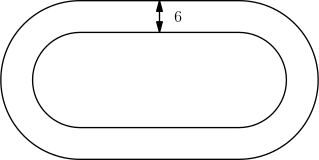
  8. Keiko walks once around a track at exactly the same constant speed every day. The sides of the track are straight, and the ends are semicircles. The track has width 66 meters, and it takes her 3636 seconds longer to walk around the outside edge of the track than around the inside edge. What is Keiko’s speed in meters per second?
  9. Two real numbers are selected independently at random from the interval [−20,10].[-20, 10]. What is the probability that the product of those numbers is greater than zero?
  10. Rectangle ABCDABCD has AB=6AB=6 and BC=3.BC=3. Point MM is chosen on side ABAB so that ∠AMD=∠CMD.\angle AMD=\angle CMD. What is the degree measure of ∠AMD?\angle AMD?
  11. A frog located at (x,y),(x, y), with both xx and yy integers, makes successive jumps of length 55 and always lands on points with integer coordinates. Suppose that the frog starts at (0,0)(0, 0) and ends at (1,0).(1, 0). What is the smallest possible number of jumps the frog makes?
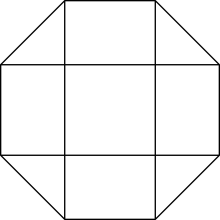
  12. A dart board is a regular octagon divided into regions as shown. Suppose that a dart thrown at the board is equally likely to land anywhere on the board. What is the probability that the dart lands within the center square?
  13. Brian writes down four integers w>x>y>zw \gt x \gt y \gt z whose sum is 44.44. The pairwise positive differences of these numbers are 1,1, 3,3, 4,4, 5,5, 6,6, and 9.9. What is the sum of the possible values for w?w?
  14. A segment through the focus FF of a parabola with vertex VV is perpendicular to FV‾\overline{FV} and intersects the parabola in points AA and B.B. What is cos⁡(∠AVB)?\cos(\angle AVB)?
  15. How many positive two-digit integers are factors of 224−1?2^{24}-1?
  16. Rhombus ABCDABCD has side length 22 and ∠B=120∘.\angle B=120^\circ. Region RR consists of all points inside the rhombus that are closer to vertex BB than any of the other three vertices. What is the area of R?R?
  17. Let f(x)=1010x,f(x)=10^{10x}, g(x)=log⁡10 ⁣(x10),g(x)=\log_{10}\!\left(\dfrac{x}{10}\right), h1(x)=g(f(x)),h_1(x)=g(f(x)), and hn(x)=h1(hn−1(x))h_n(x)=h_1(h_{n-1}(x)) for integers n≥2.n\ge2. What is the sum of the digits of h2011(1)?h_{2011}(1)?
  18. A pyramid has a square base with sides of length 11 and has lateral faces that are equilateral triangles. A cube is placed within the pyramid so that one face is on the base of the pyramid and its opposite face has all its edges on the lateral faces of the pyramid. What is the volume of this cube?
  19. A lattice point in an xyxy-coordinate system is any point (x,y)(x, y) where both xx and yy are integers. The graph of y=mx+2y=mx+2 passes through no lattice point with 0<x≤1000 \lt x \le 100 for all mm such that 12<m<a.\dfrac{1}{2} \lt m \lt a. What is the maximum possible value of a?a?
  20. Triangle ABCABC has AB=13,AB=13, BC=14,BC=14, and AC=15.AC=15. The points D,D, E,E, and FF are the midpoints of AB,AB, BC,BC, and ACAC respectively. Let X≠EX\ne E be the intersection of the circumcircles of △BDE\triangle BDE and △CEF.\triangle CEF. What is XA+XB+XC?XA+XB+XC?
  21. The arithmetic mean of two distinct positive integers xx and yy is a two-digit integer. The geometric mean of xx and yy is obtained by reversing the digits of the arithmetic mean. What is ∣x−y∣?|x-y|?
  22. Let T1T_1 be a triangle with sides 2011,2011, 2012,2012, and 2013.2013. For n≥1,n\ge1, if Tn=△ABCT_n=\triangle ABC and D,D, E,E, and FF are the points of tangency of the incircle of △ABC\triangle ABC to the sides AB,AB, BC,BC, and AC,AC, respectively, then Tn+1T_{n+1} is a triangle with side lengths AD,AD, BE,BE, and CF,CF, if it exists. What is the perimeter of the last triangle in the sequence (Tn)?(T_n)?
  23. A bug travels in the coordinate plane, moving only along the lines that are parallel to the xx-axis or yy-axis. Let A=(−3,2)A=(-3, 2) and B=(3,−2).B=(3, -2). Consider all possible paths of the bug from AA to BB of length at most 20.20. How many points with integer coordinates lie on at least one of these paths?
  24. Let P(z)=z8+(43+6)z4P(z)=z^8+(4\sqrt{3}+6)z^4 −(43+7).-(4\sqrt{3}+7). What is the minimum perimeter among all the 88-sided polygons in the complex plane whose vertices are precisely the zeros of P(z)?P(z)?
  25. For every mm and kk integers with kk odd, denote by [mk]\left[\dfrac{m}{k}\right] the integer closest to mk.\dfrac{m}{k}. For every odd integer k,k, let P(k)P(k) be the probability that [nk]+[100−nk]=[100k]\left[\dfrac{n}{k}\right]+\left[\dfrac{100-n}{k}\right]=\left[\dfrac{100}{k}\right] for an integer nn randomly chosen from the interval 1≤n≤99!.1\le n\le99!. What is the minimum possible value of P(k)P(k) over the odd integers kk in the interval 1≤k≤99?1\le k\le99?

0 of 25 answered. Each problem left blank still scores 1.5 points.

Practise one problem at a time, with hints and solutions, on the practice page. Or work through the same ideas across every year by topic, or browse the full AMC 12 archive.