2017 AMC 12A Problem 16
Problem 16 of 25IntermediateGeometry
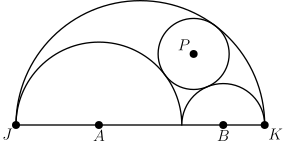
In the figure below, semicircles with centers at and and with radii and respectively, are drawn in the interior of, and sharing bases with, a semicircle with diameter The two smaller semicircles are externally tangent to each other and internally tangent to the largest semicircle. A circle centered at is drawn externally tangent to the two smaller semicircles and internally tangent to the largest semicircle. What is the radius of the circle centered at
Answer choices
Show solution
Solution
The large semicircle has radius and center the midpoint of Placing at the origin, along the base. Let be the radius of the circle at
By tangency, and Dropping a perpendicular from to the base at horizontal position with height the Pythagorean theorem gives
Equating the first expression with the middle one gives while equating the last expression with the middle one gives Adding yields so
Thus, the correct answer is B.
Tagged: tangent circles · Pythagorean Theorem · coordinate geometry