2012 AMC 10A Problem 25
Problem 25 of 25HarderGeometryProbability & StatisticsProblem-Solving Techniques
Real numbers and are chosen independently and at random from the interval for some positive integer The probability that no two of and are within unit of each other is greater than What is the smallest possible value of
Answer choices
Show solution
Solution
This problem lends itself to geometric probability since we can view the interval as a range on an axis.
WLOG, let
Then we have that the points which satisfy this restriction form a tetrahedron.
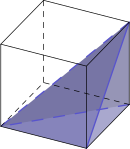 The height of this tetrahedron is and the base has an area of This makes the volume
Now we have to apply the restrictions from the problem statement. We need to find the region where
From our ordering condition that we imposed, these inequalities reduce to
These two restrictions form another tetrahedron as shown below.
The height of this tetrahedron is and the base has an area of This makes the volume
Now we have to apply the restrictions from the problem statement. We need to find the region where
From our ordering condition that we imposed, these inequalities reduce to
These two restrictions form another tetrahedron as shown below.
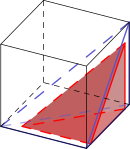 Note that in the new tetrahedron, all the dimensions have been reduced by This makes the height and the base
The volume is then
The desired probability is then
Plugging in all the answer choices, we get that the smallest value such that this fraction is greater than is
Thus, D is the correct answer.
Note that in the new tetrahedron, all the dimensions have been reduced by This makes the height and the base
The volume is then
The desired probability is then
Plugging in all the answer choices, we get that the smallest value such that this fraction is greater than is
Thus, D is the correct answer.
The height of this tetrahedron is and the base has an area of This makes the volume
Now we have to apply the restrictions from the problem statement. We need to find the region where
From our ordering condition that we imposed, these inequalities reduce to
These two restrictions form another tetrahedron as shown below.
Note that in the new tetrahedron, all the dimensions have been reduced by This makes the height and the base
The volume is then
The desired probability is then
Plugging in all the answer choices, we get that the smallest value such that this fraction is greater than is
Thus, D is the correct answer.Tagged: geometric probability · volume · symmetry