2020 AMC 10A

All 25 problems from the 2020 AMC 10A. Take it as a timed mock test — 1:15:00 on the clock, scored the way the real contest is — or read through the problems and open any of them for hints and a worked solution.

25 problems · 6 points correct, 1.5 for blank, 0 for wrong
  1. What value of xx satisfies x−34=512−13?x- \frac{3}{4} = \frac{5}{12} - \frac{1}{3}?
  2. The numbers 3,3, 5,5, 7,7, a,a, and bb have an average (arithmetic mean) of 15.15. What is the average of aa and b?b?
  3. Assuming a≠3,a\neq3, b≠4,b\neq4, and c≠5,c\neq5, what is the value in simplest form of the following expression? a−35−c⋅b−43−a⋅c−54−b\frac{a-3}{5-c} \cdot \frac{b-4}{3-a} \cdot \frac{c-5}{4-b}
  4. A driver travels for 22 hours at 6060 miles per hour, during which her car gets 3030 miles per gallon of gasoline. She is paid $0.50\$0.50 per mile, and her only expense is gasoline at $2.00\$2.00 per gallon. What is her net rate of pay, in dollars per hour, after this expense?
  5. What is the sum of all real numbers xx for which ∣x2−12x+34∣=2?|x^2-12x+34|=2?
  6. How many 44-digit positive integers (that is, integers between 10001000 and 9999,9999, inclusive) having only even digits are divisible by 5?5?
  7. The 2525 integers from −10-10 to 14,14, inclusive, can be arranged to form a 55-by-55 square in which the sum of the numbers in each row, the sum of the numbers in each column, and the sum of the numbers along each of the main diagonals are all the same. What is the value of this common sum?
  8. What is the value of 1+2+3−4+5+6+7−8+⋯+197+198+199−200? \begin{aligned} &1+2+3-4+5+6+7-8\\ &\quad+\cdots\\ &\quad+197+198+199-200? \end{aligned}
  9. A single bench section at a school event can hold either 77 adults or 1111 children. When NN bench sections are connected end to end, an equal number of adults and children seated together will occupy all the bench space. What is the least possible positive integer value of N?N?
  10. Seven cubes, whose volumes are 1,1, 8,8, 27,27, 64,64, 125,125, 216,216, and 343343 cubic units, are stacked vertically to form a tower in which the volumes of the cubes decrease from bottom to top. Except for the bottom cube, the bottom face of each cube lies completely on top of the cube below it. What is the total surface area of the tower (including the bottom) in square units?
  11. What is the median of the following list of 40404040 numbers? 1,2,3,…,2020,12,22,32,…,20202 \begin{aligned} &1,2,3,\ldots,2020,\\ &1^2,2^2,3^2,\ldots,2020^2 \end{aligned}
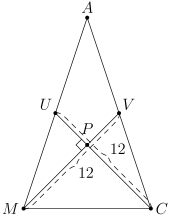
  12. Triangle AMCAMC is isosceles with AM=AC.AM = AC. Medians MV‾\overline{MV} and CU‾\overline{CU} are perpendicular to each other, and MV=CU=12.MV=CU=12. What is the area of △AMC?\triangle AMC?
  13. A frog sitting at the point (1,2)(1, 2) begins a sequence of jumps, where each jump is parallel to one of the coordinate axes and has length 1,1, and the direction of each jump (up, down, right, or left) is chosen independently at random. The sequence ends when the frog reaches a side of the square with vertices (0,0),(0, 0), (0,4),(0, 4), (4,4),(4, 4), and (4,0).(4, 0). What is the probability that the sequence of jumps ends on a vertical side of the square?
  14. Real numbers xx and yy satisfy x+y=4x + y = 4 and x⋅y=−2.x \cdot y = -2. What is the value of x+x3y2+y3x2+y?x + \frac{x^3}{y^2} + \frac{y^3}{x^2} + y?
  15. A positive integer divisor of 12!12! is chosen at random. The probability that the divisor chosen is a perfect square can be expressed as mn,\frac{m}{n}, where mm and nn are relatively prime positive integers. What is m+n?m+n?
  16. A point is chosen at random within the square in the coordinate plane whose vertices are (0,0),(0, 0), (2020,0),(2020, 0), (2020,2020),(2020, 2020), and (0,2020).(0, 2020). The probability that the point is within dd units of a lattice point is 12.\tfrac{1}{2}. (A point (x,y)(x, y) is a lattice point if xx and yy are both integers.) What is dd to the nearest tenth?
  17. Define P(x)=(x−12)(x−22)⋯(x−1002). \begin{aligned} P(x)={}&(x-1^2)(x-2^2)\\ &\cdots(x-100^2). \end{aligned} How many integers nn are there such that P(n)≤0?P(n)\leq 0?
  18. Let (a,b,c,d)(a,b,c,d) be an ordered quadruple of not necessarily distinct integers, each one of them in the set {0,1,2,3}.\{0,1,2,3\}. For how many such quadruples is it true that a⋅d−b⋅ca\cdot d-b\cdot c is odd? (For example, (0,3,1,1)(0,3,1,1) is one such quadruple, because 0⋅1−3⋅1=−30\cdot 1-3\cdot 1 = -3 is odd.)
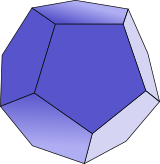
  19. As shown in the figure below, a regular dodecahedron (the polyhedron consisting of 1212 congruent regular pentagonal faces) floats in space with two horizontal faces. Note that there is a ring of five slanted faces adjacent to the top face, and a ring of five slanted faces adjacent to the bottom face. How many ways are there to move from the top face to the bottom face via a sequence of adjacent faces so that each face is visited at most once and moves are not permitted from the bottom ring to the top ring?
  20. Quadrilateral ABCDABCD satisfies ∠ABC=∠ACD=90∘,\angle ABC = \angle ACD = 90^{\circ}, AC=20,AC=20, and CD=30.CD=30. Diagonals AC‾\overline{AC} and BD‾\overline{BD} intersect at point E,E, and AE=5.AE=5. What is the area of quadrilateral ABCD?ABCD?
  21. There exists a unique strictly increasing sequence of nonnegative integers a1<a2<⋯<aka_1<a_2<\cdots<a_k such that 2289+1217+1=2a1+2a2+⋯+2ak.\frac{2^{289}+1}{2^{17}+1}=2^{a_1}+2^{a_2}+\cdots+2^{a_k}. What is k?k?
  22. For how many positive integers n≤1000n \le 1000 is⌊998n⌋+⌊999n⌋+⌊1000n⌋\left\lfloor \dfrac{998}{n} \right\rfloor+\left\lfloor \dfrac{999}{n} \right\rfloor+\left\lfloor \dfrac{1000}{n}\right \rfloornot divisible by 3?3? (Recall that ⌊x⌋\lfloor x \rfloor is the greatest integer less than or equal to x.x.)
  23. Let TT be the triangle in the coordinate plane with vertices (0,0),(0,0), (4,0),(4,0), and (0,3).(0,3). Consider the following five isometries (rigid transformations) of the plane: rotations of 90∘,90^{\circ}, 180∘,180^{\circ}, and 270∘270^{\circ} counterclockwise around the origin, reflection across the xx-axis, and reflection across the yy-axis. How many of the 125125 sequences of three of these transformations (not necessarily distinct) will return TT to its original position? (For example, a 180∘180^{\circ} rotation, followed by a reflection across the xx-axis, followed by a reflection across the yy-axis will return TT to its original position, but a 90∘90^{\circ} rotation, followed by a reflection across the xx-axis, followed by another reflection across the xx-axis will not return TT to its original position.)
  24. Let nn be the least positive integer greater than 10001000 for which gcd⁡(63,n+120)=21andgcd⁡(n+63,120)=60. \begin{gathered} \gcd(63,n+120)=21\\ \text{and}\\ \gcd(n+63,120)=60. \end{gathered} What is the sum of the digits of n?n?
  25. Jason rolls three fair standard six-sided dice. Then he looks at the rolls and chooses a subset of the dice (possibly empty, possibly all three dice) to reroll. After rerolling, he wins if and only if the sum of the numbers face up on the three dice is exactly 7.7. Jason always plays to optimize his chances of winning. What is the probability that he chooses to reroll exactly two of the dice?

0 of 25 answered. Each problem left blank still scores 1.5 points.

Practise one problem at a time, with hints and solutions, on the practice page. Or work through the same ideas across every year by topic, or browse the full AMC 10 archive.