2021 Fall AMC 10B Problem 15

Problem 15 of 25IntermediateGeometry

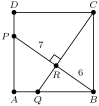
In square ABCD,ABCD, points PP and QQ lie on AD\overline{AD} and AB,\overline{AB}, respectively. Segments BP\overline{BP} and CQ\overline{CQ} intersect at right angles at R,R, with BR=6BR = 6 and PR=7.PR = 7. What is the area of the square?

Answer choices

Show solution

Solution

Since BR=6BR=6 and PR=7,PR=7, we have BP=13.BP=13. The right-angle and square-angle chasing gives PABQBC,\triangle PAB\cong\triangle QBC, so CQ=BP=13.CQ=BP=13. Because BPCQ,BP\perp CQ, point RR is the foot of the altitude from BB to the hypotenuse CQCQ of right triangle BQC.BQC. Thus QRRC=BR2=36QR\cdot RC=BR^2=36 and QR+RC=CQ=13.QR+RC=CQ=13. So QRQR and RCRC are 44 and 9.9. Because PP lies on AD,\overline{AD}, we have APAB.AP\le AB. Congruence gives BQ=AP,BQ=AP, while the right-triangle projection formulas give BQ2=CQQRBQ^2=CQ\cdot QR and BC2=CQRC.BC^2=CQ\cdot RC. Hence QRRC,QR\le RC, so QR=4QR=4 and RC=9.RC=9. Therefore, BC2=BR2+RC2=62+92=117. \begin{aligned} BC^2&=BR^2+RC^2\\ &=6^2+9^2\\ &=117. \end{aligned} The area of the square is 117.117. Thus, the answer is D .

More practice

Concepts: square (geometry) · congruence (geometry) · similarity · Pythagorean Theorem

Problem text and solution from the LIVE past-contest archive. See also the AoPS wiki page for community solutions.