2021 Fall AMC 10B Problem 25
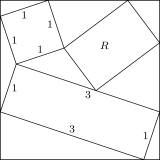
A rectangle with side lengths and a square with side length and a rectangle are inscribed inside a larger square as shown. The sum of all possible values for the area of can be written in the form where and are relatively prime positive integers. What is
Answer choices
Show solution
Solution
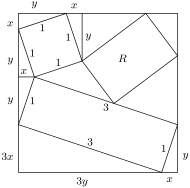 Use similar triangles as shown in the diagram. The left side of the large square has length and the bottom side has length Since these are equal, so The side length of the large square is therefore
In the upper part of the figure, let the marked horizontal segment be The two right triangles formed by the sides of rectangle have parallel corresponding sides and equal hypotenuses, so they are congruent. This gives the lengths shown below.
Use similar triangles as shown in the diagram. The left side of the large square has length and the bottom side has length Since these are equal, so The side length of the large square is therefore
In the upper part of the figure, let the marked horizontal segment be The two right triangles formed by the sides of rectangle have parallel corresponding sides and equal hypotenuses, so they are congruent. This gives the lengths shown below.
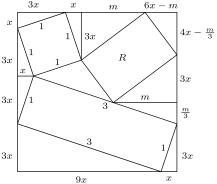 Similar triangles give Hence so
If rectangle has side length in both directions, so its area is If its side lengths are and so its area is
The two possible areas sum to Since the rectangle gives we have The sum of the possible areas is
Thus and the answer is E .
Similar triangles give Hence so
If rectangle has side length in both directions, so its area is If its side lengths are and so its area is
The two possible areas sum to Since the rectangle gives we have The sum of the possible areas is
Thus and the answer is E .Tagged: similarity · square (geometry) · quadratic