AMC 12 Mock Exam 1 Problem 18
Problem 18 of 25
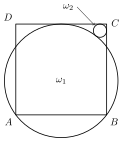
Square has side length . Circle passes through and and is tangent to side . Circle lies inside the square, is tangent to sides and , and is externally tangent to , as shown. What is the radius of ?
Answer choices
Show solution
Solution
Place , , , . By symmetry the center of lies on the perpendicular bisector of , and tangency to (the line ) means its radius is if its center is . Passing through gives , so , , and . (It touches at its midpoint .)
A circle of radius inside the square tangent to () and () has center . External tangency to requires the distance between centers to equal : The right side minus the second term on the left is , so , i.e., , giving . Only fits inside the square, so the radius is .
Tagged: circles in a square: tangency via coordinates