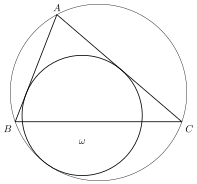
In triangle ABC, AB=13, BC=14, and CA=15. A circle ω is tangent to both rays AB and AC, and is internally tangent to the circumcircle of triangle ABC (so ω lies inside the circumcircle, as shown; the figure is not necessarily drawn to scale). What is the radius of ω?
Answer choices
Show solution
Solution
Let R and r be the circumradius and inradius of △ABC, with angles A,B,C at the vertices. The center P of ω lies on the bisector of ∠A, say AP=t, and ω has radius ρ=tsin2A.
Let O be the circumcenter. The line AO makes an angle 2B−C with the bisector of ∠A (the bisector bisects the angle between AO and the altitude from A, and the latter makes the angle ∣B−C∣ with AO). Internal tangency means OP=R−ρ. By the law of cosines in △AOP (with AO=R), t2+R2−2tRcos2B−C=(R−tsin2A)2. Expanding, t2(1−sin22A)=2tR(cos2B−C−sin2A). Because sin2A=cos2B+C, cos2B−C−cos2B+C=2sin2Bsin2C, so tcos22A=4Rsin2Bsin2C. Multiplying by sin2A and using r=4Rsin2Asin2Bsin2C, ρ=cos22Ar.
For the 13–14–15 triangle, the area is 84 and s=21, so r=2184=4. With a=14, b=15, c=13: cosA=2⋅15⋅13152+132−142=6533, so cos22A=21+cosA=6549. Therefore ρ=4⋅4965=49260.
(Why the other values appear: the analogous circles at B and C have radii cos2(B/2)4=952 and cos2(C/2)4=5.)
Tagged: circle tangent to two sides and the circumcircle (mixtilinear incircle)